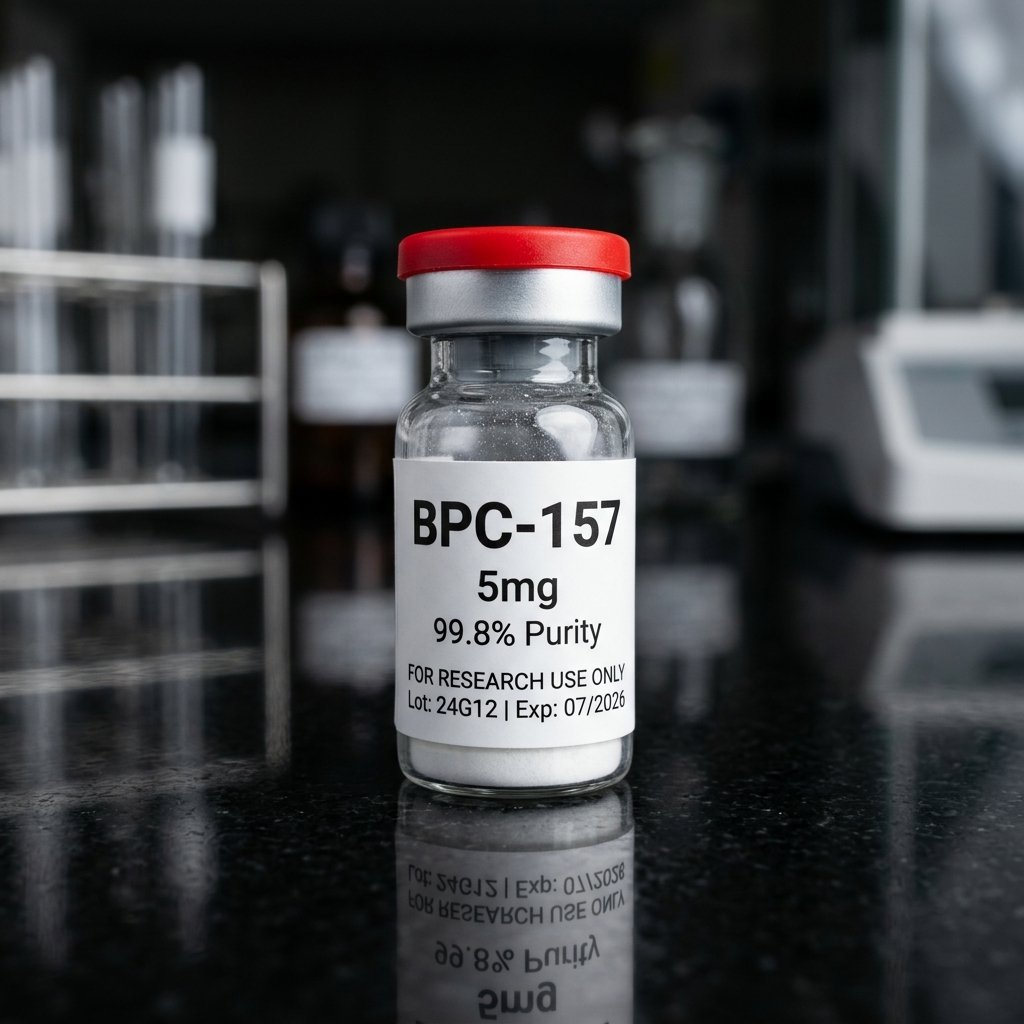
If there's one question we get more than any other, it's this one: BPC-157 or TB-500? Both are staples of tissue-repair research, both have extensive usage histories, and both frequently show up in the same comparative protocols — which makes picking between them genuinely confusing if you're new to this catalog. Here's a straight comparison to help you decide, plus why a growing number of labs stop choosing and order both.
BPC-157 at a glance
BPC-157 is a synthetic fragment derived from a naturally occurring gastric protective protein. It's one of the most-studied sequences in cellular and tissue repair research, with a large body of comparative literature behind it. Our stock ships at 99.85% HPLC purity as a lyophilized powder, HPLC and mass-spec verified before release, supporting extended cold storage prior to reconstitution.
TB-500 at a glance
TB-500 (Thymosin Beta-4) is a synthetic fragment of a naturally occurring actin-regulating protein, most frequently studied in cellular migration and tissue-repair models. It ships at 99.78% HPLC purity in a vacuum-sealed glass vial to preserve stability, with batch-specific analytical documentation available on request.
Where they differ
- Origin: BPC-157 derives from a gastric protective protein; TB-500 derives from an actin-regulating protein — different biological starting points.
- Research focus: BPC-157 is more frequently referenced in localized tissue-repair models, while TB-500 is more commonly studied for cellular migration pathways.
- Format: BPC-157 is supplied as a lyophilized powder; TB-500 as a vacuum-sealed glass vial.
- Purity spec: 99.85% vs. 99.78% HPLC — both comfortably within our standard research-grade threshold.
Where they overlap
Despite different origins, the two are frequently discussed together in the literature because their downstream research applications overlap substantially in tissue-repair pathway studies. That overlap is exactly why comparative protocols often run both side by side rather than treating them as substitutes for one another.
Why some labs order both
Rather than running two separate orders, a number of research accounts opt for our premixed BPC-157 + TB-500 Blend — a single vial pairing 5 mg of each peptide, with each component independently purity-tested prior to blending and a combined Certificate of Analysis issued per batch. It's a straightforward way to study both compounds' complementary roles without managing two separate reorder schedules.