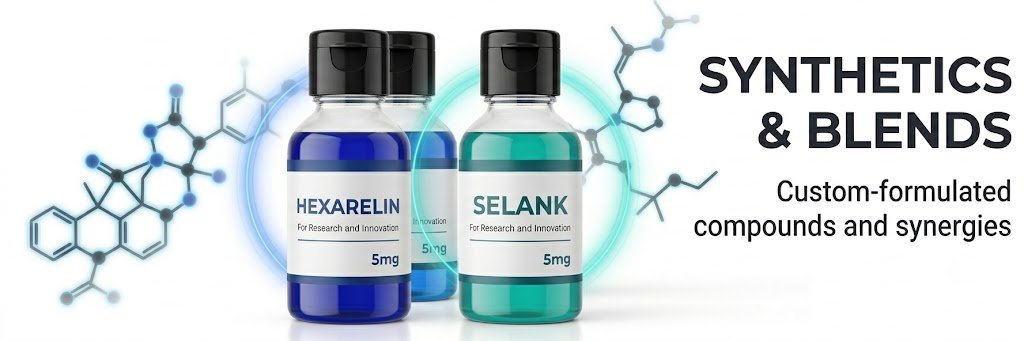
Growth-hormone secretagogues (GHS) all push toward the same downstream outcome — stimulating growth-hormone release — but they get there through different receptor mechanisms, which matters a great deal when you're designing a comparative protocol. Here's how the five most-ordered GHS peptides in our catalog differ, and how to think about combining them.
Two receptor families, one goal
Broadly, catalog GHS peptides fall into two mechanism groups: GHRH analogs, which extend or mimic the natural growth-hormone-releasing hormone signal, and ghrelin receptor agonists, which stimulate release through a separate pathway entirely. Combining one from each group is the basis of most dual-pathway secretagogue research designs.
GHRH analogs: Sermorelin & CJC-1295
- Sermorelin — a truncated GHRH analog, 99.82% HPLC purity, used to study the GHRH receptor pathway and downstream endocrine signaling directly.
- CJC-1295 with DAC — a modified GHRH analog with a Drug Affinity Complex extension for a longer research half-life versus unmodified fragments, 99.81% HPLC purity.
Ghrelin receptor agonists: Ipamorelin, GHRP-2 & GHRP-6
- Ipamorelin — a selective ghrelin receptor (GHS-R) agonist pentapeptide, 99.79% HPLC purity, studied for minimal reported off-target receptor engagement relative to earlier-generation secretagogues.
- GHRP-2 — a synthetic hexapeptide ghrelin receptor agonist, 99.83% HPLC purity, studied for downstream growth-hormone secretagogue signaling.
- GHRP-6 — closely related to GHRP-2, 99.76% HPLC purity, also examined in appetite-related pathway research alongside its secretagogue activity.
Why dual-pathway blends are common
Pairing a GHRH analog with a ghrelin receptor agonist — most commonly CJC-1295 with Ipamorelin — lets a protocol study both mechanisms acting on the same system simultaneously, rather than sequentially. That's exactly why our premixed CJC-1295 + Ipamorelin Blend and Growth Hormone Stack Kit (Sermorelin + Ipamorelin) exist as catalog items: they remove the extra step of sourcing and combining two vials independently.
Picking a starting combination
If your protocol only needs one mechanism, Sermorelin or Ipamorelin alone are the cleaner single-pathway choices. If you're studying combined receptor activity, start with one of the premixed blends — the components are independently verified before blending, so you're not troubleshooting whether a batch inconsistency came from mixing two separately-sourced vials yourself.