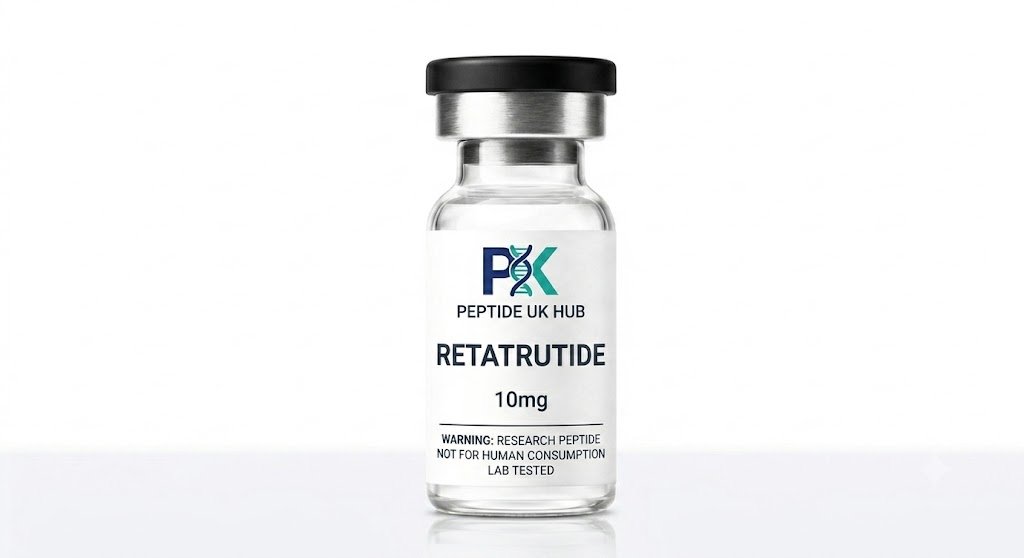
Retatrutide is the newest addition to the GLP-pathway research peptides, and one of the least-documented in UK catalog listings despite growing order volume. If you're already running Semaglutide or Tirzepatide protocols and wondering what a third-receptor compound adds to a comparative study, this is where that question gets answered.
What is Retatrutide?
Retatrutide — catalogued as RTA GLP-3 by research suppliers — is a synthetic peptide sequence designed to engage three distinct metabolic receptors in one molecule:
- GLP-1 (glucagon-like peptide-1 receptor)
- GIP (glucose-dependent insulinotropic polypeptide receptor)
- Glucagon receptor
That triple-receptor profile is what earns it the GLP-3 designation in research catalogs, distinguishing it from Semaglutide (a single GLP-1 agonist) and Tirzepatide (a dual GLP-1/GIP agonist). Each additional receptor target represents a distinct pathway a comparative protocol can isolate and study.
How it differs from Semaglutide and Tirzepatide
This is usually the first question researchers ask, and the answer is mechanistic rather than a matter of degree:
| Compound | Receptor Targets | Classification |
|---|---|---|
| Semaglutide | GLP-1 | Single agonist |
| Tirzepatide | GLP-1 + GIP | Dual agonist |
| Retatrutide (RTA GLP-3) | GLP-1 + GIP + Glucagon | Triple agonist |
The glucagon receptor component is the key differentiator. Where GLP-1 and GIP receptor activity primarily relates to insulin signaling and appetite pathways, glucagon receptor engagement adds a research angle on hepatic glucose output and energy-expenditure pathways — a mechanism the single- and dual-agonist compounds don't touch.
Background
Retatrutide originated as a pharmaceutical development candidate studied in early-phase clinical research before becoming available as a research-grade peptide through specialist suppliers. That development history is part of why documentation and receptor-binding data for this sequence are more extensive than for many newer research peptides — there's a substantial published record to compare laboratory findings against.
Retatrutide is not approved for clinical or therapeutic use in the UK. It is supplied strictly as a research-use-only compound, and all procurement and handling should remain within a research context.
Why it's showing up in UK research orders
A few things are driving reorder volume for this compound:
- Comparative protocol design. Labs already running Semaglutide or Tirzepatide protocols are adding Retatrutide as a third-arm comparator, letting a single study design span single, dual, and triple receptor agonism.
- Glucagon pathway interest. The glucagon receptor's role in hepatic metabolism and energy expenditure is an active area of academic interest, and Retatrutide is one of the few catalog compounds that engages it directly.
- Domestic UK availability. Verified RTA GLP-3 previously required international sourcing, with the customs and cold-chain risk that carries. It's now available with UK-domestic fulfilment from our Glasgow distribution hub.
- Purity requirements. Comparative research needs consistent purity across compared compounds. Our Retatrutide (RTA GLP-3) 10 mg ships at 99.75% HPLC purity with a published Certificate of Analysis per batch.
What to check when sourcing Retatrutide
A few things are worth insisting on regardless of supplier:
- HPLC purity above 99% — anything lower introduces structural variability that compromises comparability across a protocol.
- Mass spectrometry confirmation — HPLC alone tells you relative purity; MS confirms the compound present actually matches the expected molecular weight. A proper COA should show both.
- Lot-specific documentation — a generic certificate attached to a listing isn't verifiable. Look for a COA tied to the batch number printed on the vial itself.
- Domestic UK fulfilment — avoids customs holds and reduces the temperature-excursion window during transit.
- Cold-chain handling — as a lyophilized peptide, structural integrity depends on proper temperature control from dispatch to delivery.
Storage and handling
- Lyophilized form: store at -20°C for long-term stability.
- After reconstitution: keep refrigerated at 4°C and use within your protocol's defined timeline.
- Avoid repeated freeze-thaw cycles — these degrade structural integrity over time.
- Protect from light — UV exposure affects peptide stability; the amber vials we ship in provide this protection.
For reconstitution-specific guidance, see our article on bacteriostatic vs. sterile water.
Fitting Retatrutide into a comparative protocol
A common structure for labs building a receptor-agonism comparison looks like this:
| Research Arm | Compound | Receptor Profile |
|---|---|---|
| Arm A | Semaglutide 5 mg | GLP-1 |
| Arm B | Tirzepatide 10 mg | GLP-1 + GIP |
| Arm C | Retatrutide 10 mg | GLP-1 + GIP + Glucagon |
All three are available with consistent purity standards and batch-matched COA documentation, which keeps sourcing variables out of the comparison.