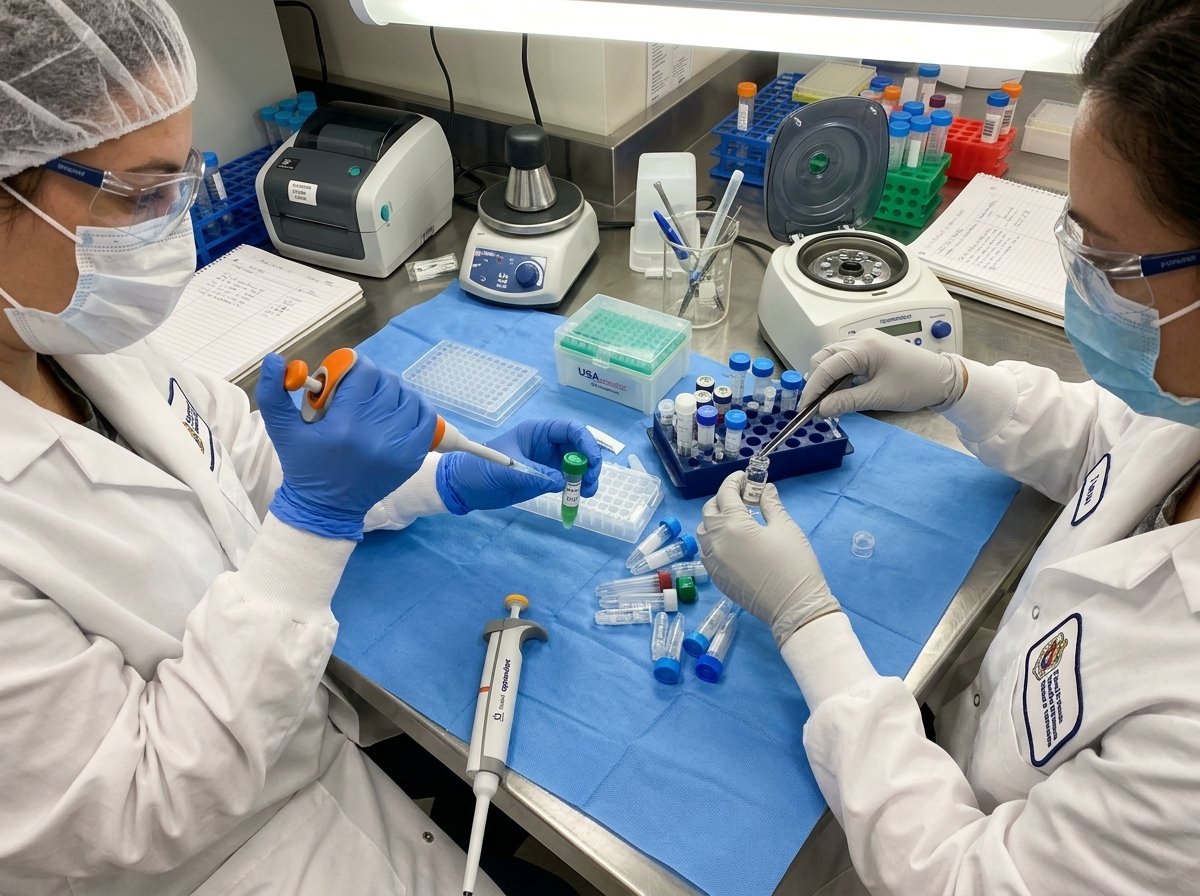
Research peptides are typically supplied in one of two physical forms: lyophilized (freeze-dried) powder or a pre-mixed liquid solution. The distinction affects shelf life, handling requirements, and how a compound needs to be prepared before it can be used in a research protocol. Understanding the difference helps explain why suppliers list one format or the other, and why storage instructions vary between products.
What "lyophilized" means
Lyophilization is a freeze-drying process: a solution is frozen solid, then placed under vacuum so that the frozen water sublimates directly from solid to vapour without passing through a liquid phase. What remains is a stable, porous powder cake containing the peptide with minimal residual moisture. This process is chosen specifically because it preserves molecular structure better than simple air- or heat-drying, which can degrade sensitive compounds.
What liquid-form products are
Liquid-form research peptides are supplied already dissolved in a diluent or buffer at a fixed concentration, ready for use without a reconstitution step. This removes a handling step but means the peptide is already in solution from the point of manufacture, which has implications for stability.
Stability and shelf-life differences
Lyophilized powder is generally more stable over longer periods when stored correctly, since the absence of water limits the hydrolysis and microbial activity that degrade peptides in solution. Liquid-form products, by contrast, have a shorter practical usable window once opened and are more sensitive to temperature fluctuation, light exposure, and repeated freeze-thaw cycling.
Storage handling considerations for each
Lyophilized vials are typically stored frozen or refrigerated, protected from light and moisture, and remain stable sealed for extended periods. Once reconstituted with a diluent, the resulting solution generally has a much shorter recommended usage window. Liquid-form products need consistent cold storage from the point they arrive, and should avoid repeated freezing and thawing, which can physically damage peptide structure through ice crystal formation.
Which format suits which research context
Laboratories running infrequent or small-batch protocols often prefer lyophilized powder, since only the amount needed for a given session has to be reconstituted, leaving the remainder in its more stable dried state. Labs with immediate, high-throughput consumption sometimes prefer the convenience of ready-to-use liquid product despite its shorter stability window. Neither format is inherently "better" — the right choice depends on how quickly the material will be used and how it fits into existing laboratory storage capacity.